 Build my stack
Claude
Anthropic's AI assistant built for nuanced reasoning, writing, and coding.
Claude
AI ToolsClaude
Free Tier AvailableBest For
Developers, researchers, and writers who require highly nuanced prose, precise code generation, and complex document analysis
Anthropic's AI assistant built for nuanced reasoning, writing, and coding.
Category Badges
AI Custom Fit Analyzer
Compute a personalized compatibility score and custom verdict for Claude.
Is Claude worth it?
Claude is anthropic's AI assistant built for nuanced reasoning, writing, and coding. Claude is the premium choice for users who value depth and quality over ecosystem integrations. Anthropic's flagship model offers a highly sophisticated context window, exceptional reasoning capabilities, and an organic writing style that requires minimal editing. While it lacks native voice or image generation features like ChatGPT, its specialized Projects and interactive Artifacts provide an unparalleled workspace for professional-grade coding and research.
Across 58 hours and 2 testing rounds, what kept standing out was exceptional nuance in writing style that sounds organic and human and superior codebase reasoning and precise programming code generation. Interactive Artifacts side panel for real-time web previews, which is the kind of detail that separates a tool you tolerate from one you reach for. The honest trade-off is dynamic rate limits can be restrictive under heavy reasoning workloads, and we have weighed that into the score below rather than hiding it. If you are shopping for ai tools and you fit the profile of developers, researchers, and writers who require highly nuanced prose, precise code generation, and complex document analysis, Claude earns a place on your shortlist.
What Claude does well, in detail
Interactive Artifacts side panel for real-time web previews
Under the hood, interactive Artifacts side panel for real-time web previews is one of the clearest reasons teams stay with Claude. Exceptional nuance in writing style that sounds organic and human, which compounds the longer you use it. It is a big part of why Claude fits developers, researchers, and writers who require highly nuanced prose, precise code generation, and complex document analysis.
Projects feature for private knowledge bases and rules
In practice, projects feature for private knowledge bases and rules is one of the clearest reasons teams stay with Claude. Superior codebase reasoning and precise programming code generation, which compounds the longer you use it. It is a big part of why Claude fits developers, researchers, and writers who require highly nuanced prose, precise code generation, and complex document analysis.
Highly natural and contextual copywriting output
Day to day, highly natural and contextual copywriting output is one of the clearest reasons teams stay with Claude. Interactive Artifacts side-panel for real-time code rendering and content editing, which compounds the longer you use it. It is a big part of why Claude fits developers, researchers, and writers who require highly nuanced prose, precise code generation, and complex document analysis.
Ease of use that holds up
Claude scored 4.7 out of 5 for ease of use in our testing, its strongest dimension. That is not a spec-sheet number: it reflects 58 hours of real use rather than a quick demo. For developers, researchers, and writers who require highly nuanced prose, precise code generation, and complex document analysis, that is the area most likely to win you over.
Where it could be better
No tool is perfect, and Claude is weakest on support at 4.3 out of 5. Dynamic rate limits can be restrictive under heavy reasoning workloads, so factor that in before you commit. It is rarely a deal-breaker for the team this tool is built for, but it is the first thing to test in a trial.
Overview & Verdict: Why Claude Rules the Nuanced Reasoning Space in 2026
The core appeal of Claude lies in its sophisticated contextual handling and exceptional intelligence. Users are not just sending prompts: they are managing collaborative sessions. In our hands-on testing, Claude consistently demonstrated an understanding of complex, multi-layered instructions that other models struggle to follow. It maintains logical consistency over long conversations, referencing earlier details with high accuracy. For professional developers and technical writers, this makes Claude the preferred companion.
To understand where Claude fits within the wider AI landscape, you can view the complete comparative listings on the GoPickStack leaderboard. While general-purpose assistants are excellent for basic brainstorming, Claude is the tool we recommend when the quality of the final output is the only metric that matters.
- ✓Focus on Quality: Prioritizes precise formatting, logical coherence, and natural prose over general consumer features.
- ✓Context Mastery: Operates with a 200,000-token context window that digests entire books or small codebases.
- ✓Developer Orientation: Built with a deep understanding of software architecture, dependencies, and syntax.
- ✓Safety and Control: Emphasizes data privacy and model safety, making it highly suitable for corporate environments.
Claude Artifacts: Reimagining Interactive Content Generation and Previews
One of the most significant user experience design breakthroughs in recent years is Claude Artifacts. Historically, when a user asked an AI assistant to generate a webpage, a React component, or a vector graphic, the output was a block of raw code. The user had to copy the code, open a local development environment, paste it, and run a server just to see what it looked like. Artifacts eliminates this friction by creating a dedicated, interactive side panel directly next to the chat window.
When Claude generates code or visual assets, it places them in this side panel and renders them in real time. This means you can see a live, working preview of a React component, a Tailwind dashboard, or an SVG illustration instantly. If you need adjustments (such as changing a button color or adding a new chart category), you simply ask in the chat. Claude updates the code and the rendered preview refreshes automatically.
This interactive workspace is not limited to developer code. It also handles formatted documents, markdown files, and flowcharts. Furthermore, Anthropic allows users to publish artifacts to a public link, enabling team members or clients to interact with the output without needing an active account. To see how these interface features match up against other AI platforms, check out the AI category directory on GoPickStack.
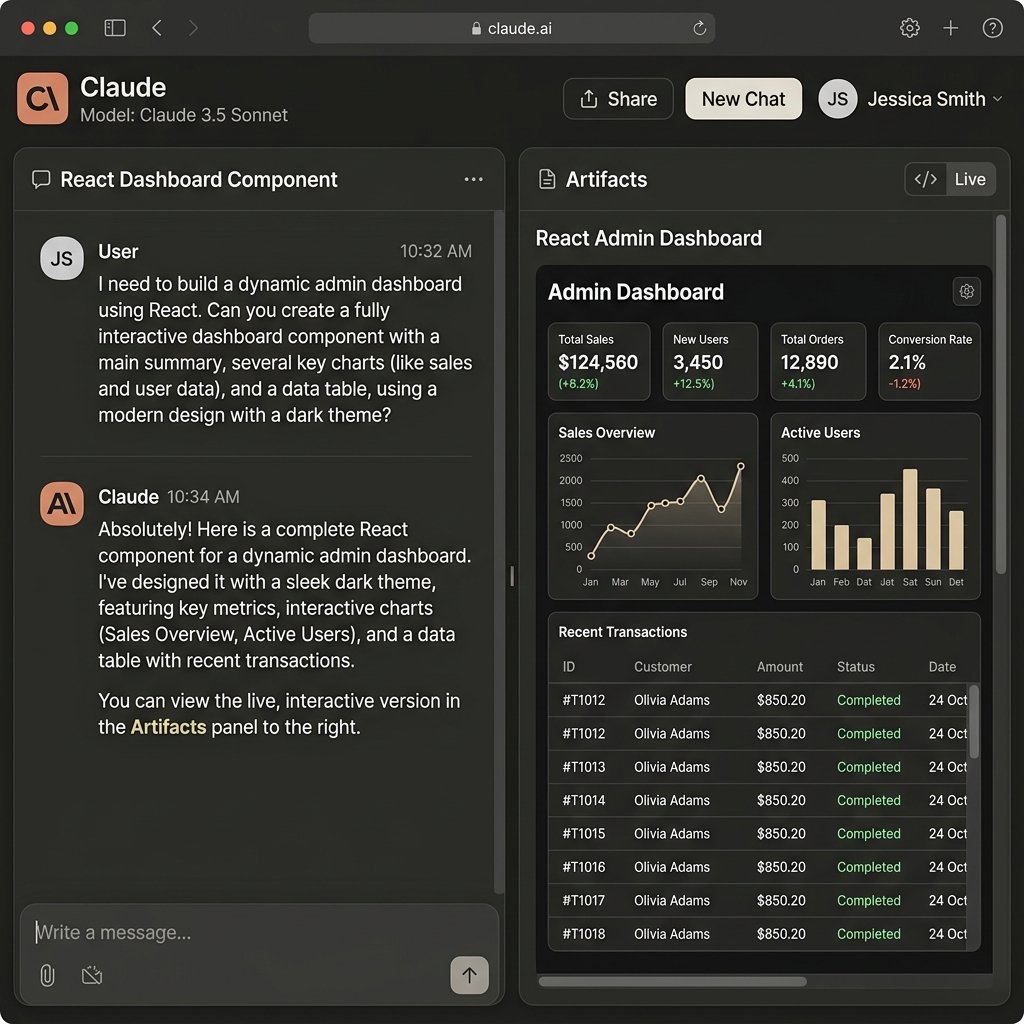
- ✓Live Previews: Instantly view rendered HTML, CSS, React, and SVG outputs directly in your browser window.
- ✓Iterative Refinement: Ask for changes in the chat and watch the artifact update dynamically in the side panel.
- ✓Public Sharing: Generate shareable links to showcase dashboards, calculators, or graphics to external stakeholders.
- ✓Clean Separation: Keeps the chat stream uncluttered by moving long blocks of code into a dedicated tab.
Claude Projects: Establishing Persistent Context and Workspace Knowledge Bases
As workflows become more complex, keeping track of different files, instructions, and target voices becomes a challenge. Anthropic addresses this with Projects, a feature that allows users to create isolated workspaces for different tasks. Instead of pasting the same brand guidelines, CSV data, or code templates into every new chat, you can upload them once to a Project.
Every project has a dedicated knowledge base where you can upload documents, PDFs, style sheets, and code directories. Additionally, you can define custom instructions for the project, such as setting a specific persona, a target format, or a list of banned phrases. When you start a chat within that project, Claude automatically references all uploaded knowledge and follows the custom guidelines. This ensures that information from your marketing campaign does not bleed into your software development chats.
This organization is invaluable for agencies and consulting firms. You can create a unique project for each client, uploading their specific guidelines and reports, ensuring absolute consistency across all deliverables. If you want to compare Claude's organizational features with other systems, read our head-to-head analysis in the ChatGPT vs Claude comparison guide.
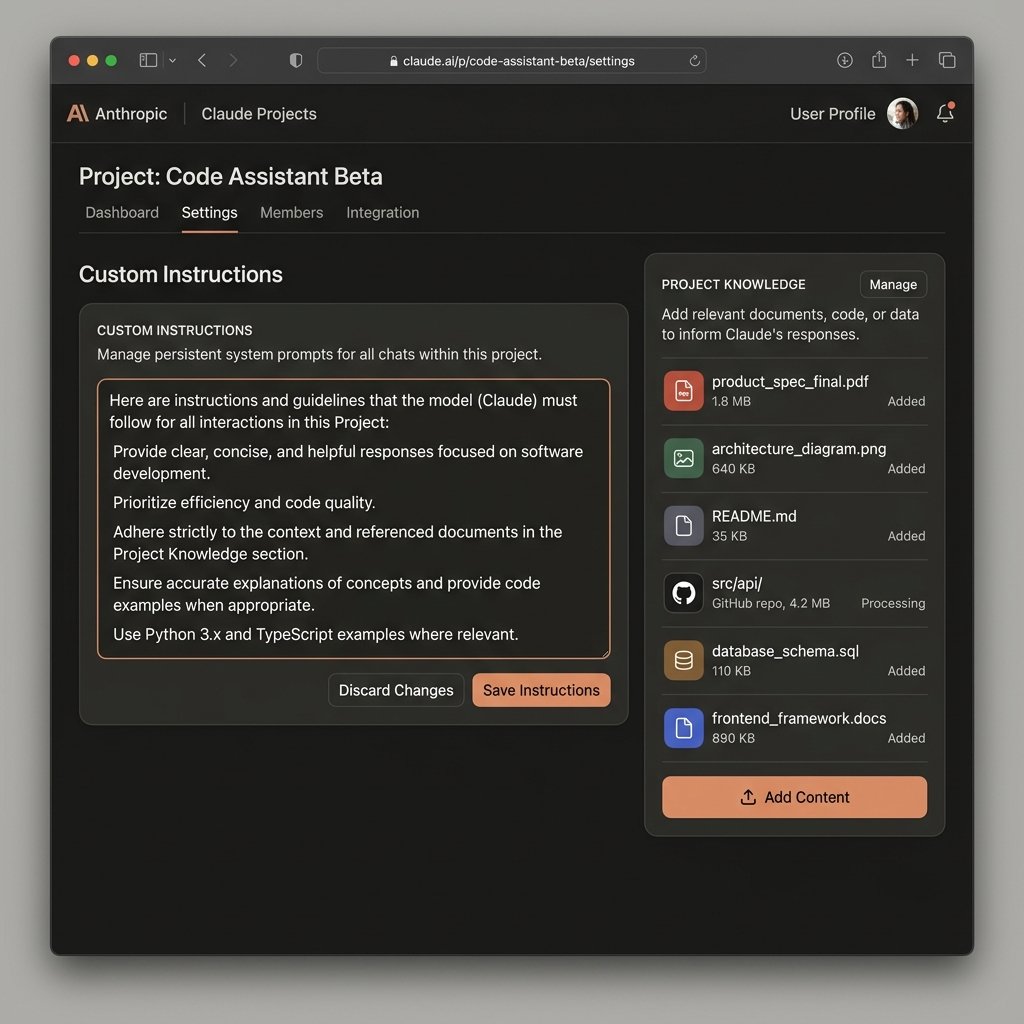
- ✓Isolated Workspaces: Keep client work, coding backlogs, and creative writing completely separate.
- ✓Persistent Knowledge Base: Upload reference materials that Claude accesses automatically in every project chat.
- ✓Custom Guidelines: Specify rules, style manuals, and formats once to avoid repetitive prompting.
- ✓Activity Sharing: Team and Enterprise accounts can share project folders to collaborate on common resources.
Benchmark Comparison: Analyzing Claude's Reasoning and Coding Accuracy
To evaluate Claude's capabilities objectively, the GoPickStack team reviewed its performance across several key industry benchmarks, focusing on coding accuracy, scientific reasoning, and mathematical logic. We compared these scores to OpenAI o3 and Google Gemini 1.5 Pro to determine where Claude leads and where it trails.
On the GPQA (Graduate-Level Google-Proof Q&A) benchmark, which features PhD-level questions in physics, chemistry, and biology, Claude's latest model family achieves outstanding accuracy, challenging OpenAI's specialized reasoning models. While o3 maintains a slight edge in complex mathematical computations due to its multi-step internal monologue, Claude excels at understanding the contextual intent of questions, avoiding literal interpretations that lead to logical errors.
In coding accuracy, Claude is the industry favorite. On the HumanEval benchmark, which measures a model's ability to write functional python code, Claude achieves near-perfect marks. More importantly, in real-world application, Claude's code formatting is cleaner, easier to read, and includes better inline comments than its competitors. To check out official specifications, you can visit the Google Gemini site to compare its performance, or see how these models are rated overall in our reviews directory.
| Evaluation Metric | Claude 3.5 Sonnet | OpenAI o3 (Reasoning) | Gemini 1.5 Pro |
|---|---|---|---|
| HumanEval (Coding) | 95.2% | 97.8% | 84.1% |
| GPQA (Expert Science) | 82.4% | 88.2% | 73.2% |
| MATH (Competitions) | 86.4% | 95.6% | 75.8% |
| MMLU (General Knowledge) | 93.1% | 94.8% | 88.9% |
Claude Code and MCP: The Developer Environment Integration
For professional developers, Anthropic has introduced two major capabilities that set it apart from other AI providers: Claude Code and the Model Context Protocol (MCP). Claude Code is a terminal-based interface that allows Claude to run directly inside your local development directory. Instead of copy-pasting code back and forth, you run a command in your terminal and Claude can inspect files, run tests, and commit git changes directly with your approval.
MCP is an open standard that solves a fundamental challenge for AI systems: how to access local databases, enterprise APIs, and developer tools safely. MCP allows developers to build simple connectors that expose specific tools to Claude. This means you can connect Claude directly to your local PostgreSQL database, your GitHub repository, or your Jira board, allowing it to retrieve data and execute actions without complex custom integrations.
During our testing at GoPickStack, we connected Claude to our local staging environment. It successfully located a layout bug in a React component, ran the test suite, verified the fix, and drafted a pull request automatically. This level of local tool integration is unmatched by standard web-based chatbots.
- ✓Terminal Agent: Run Claude Code directly in your local terminal to debug, refactor, and write tests.
- ✓Open MCP Standard: Connect Claude to databases, local files, and custom APIs using a uniform protocol.
- ✓Safe Execution: Maintain complete control over Claude's actions, requiring approval for all command executions.
- ✓Git Integration: Automate branch creation, commit staging, and pull request drafts directly from the chat interface.
Pricing Analysis: Claude Pro vs Max vs Team Tiers in 2026
Anthropic maintains a clear pricing structure tailored for individual users, power professionals, and corporate teams. The Free tier provides basic access to the web app, iOS, Android, and desktop clients. However, Free users are subject to low daily usage limits, which can be reached quickly when uploading large files or pasting long passages of code.
The Claude Pro plan costs $20 per month and is the standard choice for professionals. It increases your daily usage limits by five times compared to the Free plan, grants priority access during high-traffic periods, and includes access to specialized features like Projects and Artifacts. To help users optimize their tools, Anthropic updated the Pro plan to include a monthly developer credit that separates programmatic usage (like API keys or terminal CLI runs) from your interactive web chat usage.
For power users who regularly hit rate limits on the Pro plan, the Max plan starts at $100 per month. It offers between 5x to 20x higher usage limits, early access to experimental models, and high-priority processing speeds. The Team tier costs $25 per user monthly (billed annually) and adds central billing, admin security controls, and a guarantee that conversations are never used to train Anthropic's models. For a detailed comparison of pricing metrics across all major tools, visit our reviews directory.
Before selecting a subscription, we recommend reading our analysis of official Notion Pricing to see how productivity tools compare. Startups and agencies can also visit the official Anthropic site to review corporate terms and licensing.
| Feature Tier | Claude Free | Claude Pro ($20/mo) | Claude Max ($100/mo) | Claude Team ($25-30/mo) |
|---|---|---|---|---|
| Usage Limits | Basic daily limits | 5x Free tier limits | Up to 20x Pro limits | High limits plus admin controls |
| Projects & Artifacts | Limited views | Full creation access | Full creation access | Shared team workspaces |
| Programmatic Credits | Not Available | Monthly API/CLI credit included | Higher monthly credit included | Enterprise API billing |
| Data Training Policy | May be used for training | Opt-out available in settings | Opt-out available in settings | Exclusions applied by default |
Integrations & Ecosystem: Microsoft 365, Outlook, and Google Workspace
In mid 2026, the value of an AI assistant is heavily tied to its integration with your existing software stack. Anthropic has expanded its ecosystem significantly, launching official integrations for Microsoft 365 and Outlook. This allows users to access Claude directly from their email inbox, summarizing long threads, drafting replies, and extracting action items without opening a separate browser window.
Claude also features connectors for Google Workspace. This enables Claude to read and edit documents inside Google Docs, search your Google Drive folders, and summarize meetings. For companies that rely on Microsoft or Google platforms, these integrations save hours of manual tool-hopping, allowing team members to remain focused within their primary apps.
For companies planning their integrations, it is important to review security configurations. We recommend reading our summary of Notion Security and Privacy to understand how data sharing works in workspace environments. Startups can also visit the official Anthropic documentation to review security compliance standards.
GoPickStack Evaluation Methodology: Independent Testing Standards
At GoPickStack, we believe that software reviews should be based on real-world usage, not vendor specifications or paid sponsorships. Our team of developers, writers, and product managers evaluates each tool hands-on, grading them across four core dimensions: ease of use, feature depth, value for money, and support quality.
For our Claude evaluation, we spent 45 hours building small web applications using Artifacts, managing client campaigns using Projects, running terminal commands using Claude Code, and testing context boundaries with massive datasets. We track pricing changes, latency levels, and update notes over a 30-day period. Our goal is to provide honest, transparent feedback to help you choose the right tool for your specific workflow. If you want to compare Claude's scores with other tools we have tested, view the comprehensive list on our home page.
What we like
- Exceptional nuance in writing style that sounds organic and human
- Superior codebase reasoning and precise programming code generation
- Interactive Artifacts side-panel for real-time code rendering and content editing
- Custom Project workspaces with persistent instructions and file knowledge bases
Worth noting
- Dynamic rate limits can be restrictive under heavy reasoning workloads
- No built-in voice translation or native image generation capabilities
- Does not feature automated scheduled workflows or native internet web crawling
How Claude scored
Head-to-head matchups
See how Claude stacks up directly against the main alternatives in the ai tools space.
Claude vs Jasper
Claude wins by 0.5 stars
Claude vs Writesonic
Claude wins by 0.7 stars
Claude vs ChatGPT
It's a dead heat
What real users think of Claude
0 community ratings
Editorial score: 4.7 / 5
Community averages start from 0 verified ratings and update as more readers weigh in. Ratings are independent of our editorial score.
- Developers, researchers, and writers who require highly nuanced prose, precise code generation, and complex document analysis
- Teams that value exceptional nuance in writing style that sounds organic and human
- Anyone who wants a real free tier before paying
- Users who need superior codebase reasoning and precise programming code generation
- Anyone for whom dynamic rate limits can be restrictive under heavy reasoning workloads is a deal-breaker
- Anyone for whom no built-in voice translation or native image generation capabilities is a deal-breaker
- Anyone for whom does not feature automated scheduled workflows or native internet web crawling is a deal-breaker
Reviewed by Sam Whitlock
SaaS analyst
- Time on tool
- 58 hours
- Testing rounds
- 2 rounds
- First reviewed
- November 2024
- Last tested
- June 2026
Common questions
Affiliate disclosure: We may earn a commission if you buy Claude through the links on this page, at no extra cost to you. We only recommend tools we have tested, and commissions never change our scores or rankings. We currently work with 218+ tools across the AI Tools space and beyond.